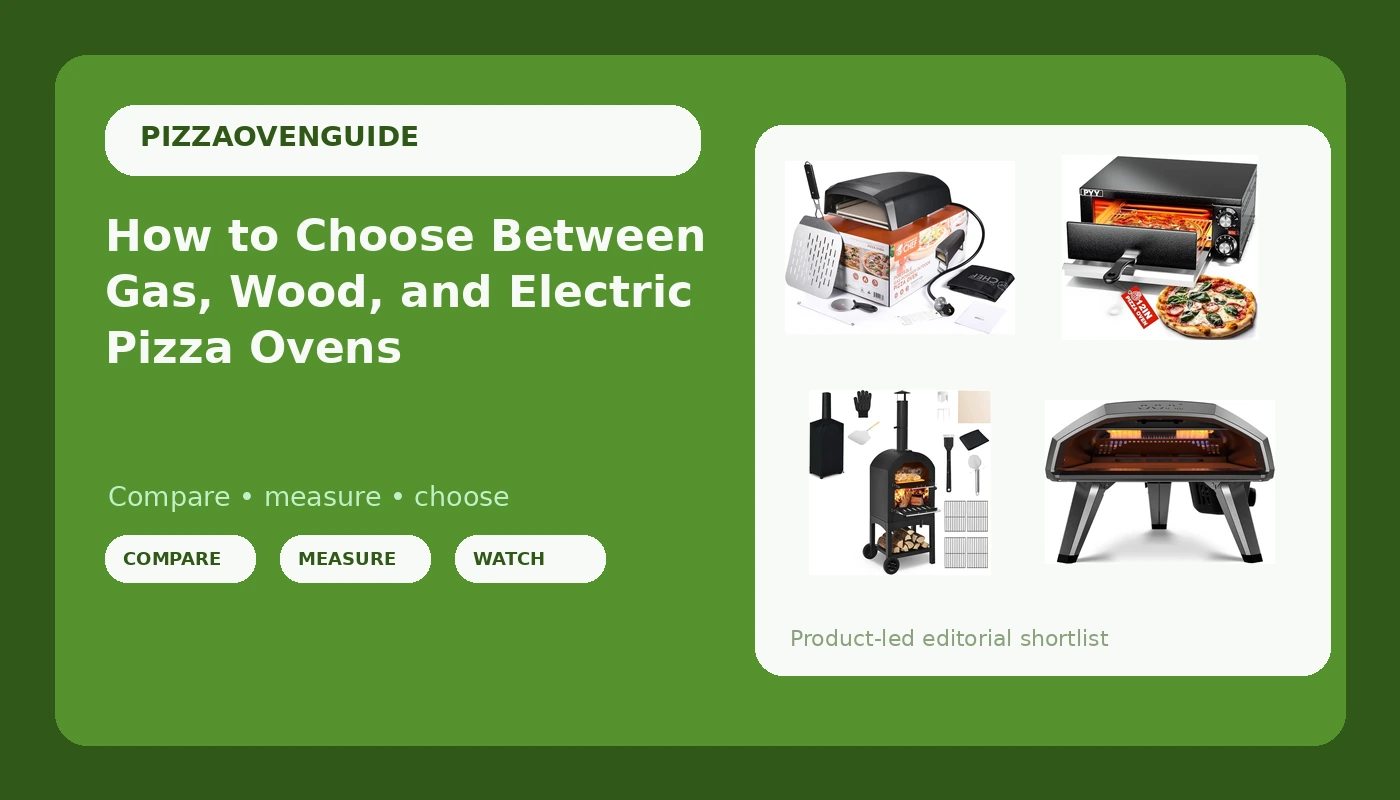
An outdoor pizza oven is a heat machine, and the machine you pick decides what kind of pizza nights you can realistically have. The category has split three ways: propane gas, wood, and countertop electric. Each path asks for a different setup, a different fuel ritual, and a different level of commitment at seven o'clock on a Tuesday. This guide looks at four ovens that represent those paths, explains what each design is genuinely good at, and helps you match one to the way you actually cook rather than to the way a product page says you should.
Related: How to Launch a Pizza Without Tearing the Dough →
Quick answer
Start with fuel, not with size. Propane gas ovens light quickly and are the easiest to run repeatedly. Wood-fired ovens reward attention and give you the most direct control over the fire itself, but they ask you to manage fuel while you are also managing dough. Countertop electric ovens plug into a standard outlet and work indoors, which makes them the practical weeknight option. No single design wins on every count, and none of the four ovens below is universally the right answer. The honest version is that the oven worth owning is the one whose fuel you will still bother to use on a random Wednesday.
Four useful options
| Model | Best fit | What stands out |
|---|---|---|
| Ooni Koda 2 Propane Gas Pizza Oven | Backyard gas cooking | Propane fuel, outdoor design, part of the Koda line |
| Commercial Chef Outdoor Gas Pizza Oven, Portable Propane Pizza Maker with Door, Peel, Stone, Cutter, and Cover - L-Shaped Burner, Foldable Legs | One-box outdoor setup | Includes door, peel, stone, cutter, and cover; L-shaped burner; foldable legs |
| PYY Electric Pizza Oven Indoor Countertop Pizza Oven Commercial Pizza Maker Machine for Home with Timer Stainless Steel Pizza Cooker | Indoor countertop baking | Electric operation, stainless steel body, built-in timer |
| COSTWAY Outdoor Pizza Oven, Wood Fired Pizza Oven for Outside | Wood-fired cooking outdoors | Wood-fired design, built for outdoor use, no propane or cord needed |
The gas pick: Ooni Koda 2 Propane Gas Pizza Oven
Gas removes the most decisions from a pizza night. There is no wood to split, no coals to arrange, and no chimney to watch. You connect a propane tank, light the burner, and wait for the stone to come up to temperature. That predictability is the entire point: the same oven behaves the same way on a Tuesday as it does on a Saturday, which is what makes a routine possible. The trade-off is control. With gas you choose a heat level and hold it, rather than steering a live fire. For anyone who wants the oven to be a tool instead of a hobby, that is a feature rather than a shortcoming.
The complete starter bundle: Commercial Chef Outdoor Gas Pizza Oven, Portable Propane Pizza Maker with Door, Peel, Stone, Cutter, and Cover - L-Shaped Burner, Foldable Legs
The appeal here is that the kit answers the "what else do I need" question before you ask it. Buying a peel, a stone, and a cover separately adds up, and it also adds a week of shopping between the oven arriving and the first pizza going in. The door is worth thinking about, because a closed oven holds heat differently than an open one and changes how you time a bake. The caveat is that bundled accessories are a starting point, not a finish line. A kit peel is usually the first thing an experienced cook replaces, and a stone in a box is rarely the thickest one available. Use the bundle to get cooking, then upgrade deliberately once you know what your oven actually needs.
The indoor pick: PYY Electric Pizza Oven Indoor Countertop Pizza Oven Commercial Pizza Maker Machine for Home with Timer Stainless Steel Pizza Cooker
An indoor electric oven is working within the limits of a household circuit, so it will not behave like a live fire, and that is the trade you accept for convenience. What you get in return is a short path from deciding to make pizza and actually making it. The timer matters more than it sounds. Consistency is the hardest thing to build in home pizza, and a timer gives you one variable you can hold steady while you work on dough and shaping. Before buying, check three practical things: a free outlet near the counter, enough clearance around the body for heat to escape, and ventilation, because an indoor oven will perfume your kitchen. Run a hood or open a window, especially for the first few bakes.
The wood-fired pick: COSTWAY Outdoor Pizza Oven, Wood Fired Pizza Oven for Outside
Wood is the option that asks the most and gives back the most. You are responsible for the fire: building it, feeding it, and reading it while pies go in and out. That means the oven demands attention in a way gas and electric do not, and it also means the cook is standing right there for the whole session, which is either the reason you are buying or the reason you should not. Two practical realities come with wood. First, ash: it has to go somewhere, and the oven has to be cleaned out between sessions. Second, weather: an outdoor fire does not care that it is windy, but you will. If your ideal pizza night is a slow one where the fire is part of the event, this is the category that delivers it.
Prices and availability may change. Product images, names, and retailer links are matched to verified listings. No current price, rating, stock status, or measured result is stated here without current evidence.
What actually decides whether an oven works for you
Fuel is the first filter, but it is not the only one. Four things decide whether an oven becomes part of your week or ends up under a tarp.
Where it lives. An outdoor oven needs a stable surface, clearance from anything flammable, and a spot where you are willing to stand for twenty minutes. A countertop electric oven needs a free outlet, counter space, and enough ventilation that your kitchen does not smell like a pizzeria two days later. Measure the space before you fall in love with a shape.
How it heats. Gas ovens heat a stone from a burner. Wood ovens heat a stone from a fire, and the fire keeps changing. Electric ovens heat from an element and hold a setting. Each gives you a different relationship with the heat, and that relationship is what you manage every time you cook.
How long it takes to be ready. A gas oven is typically ready soon after lighting. A wood oven wants time to build and settle its fire. An electric oven needs to preheat like any other appliance. The oven that takes twenty minutes longer is the oven you skip on a weeknight.
What it can hold. Recovery matters more than peak. Every time you open the oven to launch, turn, or check a pie, heat escapes. An oven with a heavy stone and a steady burner gets back to work faster, which is why two ovens with similar descriptions can feel completely different to cook on.
Fuel, footprint, and the weeknight question
Most buyers frame this as gas versus wood and forget that the real competitor is the indoor electric oven. The honest split looks like this: gas is for people who want pizza outside without a fire ritual, wood is for people who want the fire to be part of the evening, and electric is for people who want pizza on a Tuesday without leaving the kitchen.
Footprint decides more than fuel in a lot of homes. A portable gas oven with foldable legs can be stored, moved, and packed away. A wood-fired oven tends to be a fixed piece of furniture that claims a corner of a patio. A countertop electric oven takes up space you already use for something else, which is both its advantage and its cost.
A five-step way to choose
- Decide where the oven will live before you compare anything else: outdoors only, indoors only, or either one.
- Choose the fuel you will realistically use on a normal weeknight, not the fuel that sounds best in a description.
- Measure the surface, the storage space, and any doorway the oven has to pass through.
- Read what comes in the box so you are not buying a peel and a stone twice.
- Set aside budget for the two accessories that change results most: a peel you can launch from and an infrared thermometer for reading stone temperature.
Practical notes before you buy
- A propane oven still needs a tank, and a tank needs somewhere safe to live. Factor that into your plan.
- Wood-fired ovens produce ash. Decide where it goes and how you will clean the oven between sessions.
- An indoor electric oven shares your kitchen's air. Run a hood or open a window, especially on the first few bakes.
- Bundled accessory kits are a convenience, not a guarantee of quality. Expect to upgrade the peel first.
- Ignore any peak temperature claim that does not come with a stone reading from a thermometer. The number on the box is marketing; the number on the stone is dinner.
Which option should you choose?
Choose the Ooni Koda 2 Propane Gas Pizza Oven when you want the most predictable outdoor setup and you would rather cook than tend a fire. Choose the Commercial Chef Outdoor Gas Pizza Oven, Portable Propane Pizza Maker with Door, Peel, Stone, Cutter, and Cover - L-Shaped Burner, Foldable Legs when you want one purchase that arrives with a door, peel, stone, cutter, and cover so you can cook the day it shows up. Choose the PYY Electric Pizza Oven Indoor Countertop Pizza Oven Commercial Pizza Maker Machine for Home with Timer Stainless Steel Pizza Cooker when your pizza nights happen indoors on weeknights and an outlet is easier than a propane tank. Choose the COSTWAY Outdoor Pizza Oven, Wood Fired Pizza Oven for Outside when the fire itself is the point and you are happy to spend the evening feeding it.
One caveat: this comparison is about design and fit, not about measured performance. A fuel type tells you how an oven behaves and what it asks of you. It does not tell you how a specific unit will perform on your patio. Read the listing, confirm what is included, and check the details that matter for your setup before you buy.
The bottom line
Fuel first, footprint second, features last. Gas removes friction, wood adds ritual, and electric removes the walk outside. If you cook most weeks and want the least resistance, a propane oven is the sensible default. If the fire is the reason you are buying, buy the fire and accept the work that comes with it. And whatever you choose, plan on the first pizza being a calibration pie rather than dinner, because the second one is what tells you what you actually bought.