Most people who buy a countertop pizza oven make the same mistake: they treat it like a toaster. Plug it in, wait five minutes, slide a pie onto the stone, and pull out something pale and bready with a rim that never got past the color of a dinner roll. Then it goes into the garage next to the bread machine.
A countertop pizza oven is a heat machine. The machine only works when you give it what it needs: a long preheat, a stone that is genuinely saturated with heat, and a dough that can survive the ride. Everything else, the sauce, the cheese, the toppings, is just there to not get in the way.
I cooked in a Neapolitan pizzeria for five years before I moved to writing, and I now cook in a Hoboken kitchen with 22 inches of usable counter. The gap between those two worlds is smaller than you would think, but only if you run the oven correctly. What follows is the routine I use on a weeknight, plus the two indoor ovens I would clear counter space for.
Why you should trust me
I worked the oven at a Neapolitan pizzeria for five years, and I have spent the last three testing pizza ovens at home. Eight of them so far, from a cheap countertop box to a wood-fired dome.
Every oven gets the same treatment before I write a word about it. At least eight pies. The same two doughs every time, one straight dough and one 48-hour cold ferment, so the results compare. An infrared thermometer reading off the stone before the first launch and again at the end of the session. I score each pie on char, leoparding, rim rise, and bottom crisp, and I keep the photos. If I cooked on a loaned unit, I say so. If the box claims a number the stone never reaches, I say that too.
That is the whole method. Same dough, same launch, same scorecard, different oven.
How I picked and how I tested
This article covers the indoor electric countertop class, because that is the class most people can actually use on a Tuesday. No fire to light, no propane to swap, no weather to argue with. Plug it in, preheat it, eat at 7:30.
The two ovens below sit at the two ends of that class. The Presto is the rotating budget box, the one that does the turning for you while you learn to launch. The Breville is the premium indoor electric, the one I point people to when pizza night has to happen on a schedule. Both got the same dough, the same stone temp check with an infrared thermometer, and the same eight-pie minimum.
Two numbers I trust and one I do not. Stone temp, measured at the middle of the stone, is the only spec that predicts what your crust will look like. Rim rise tells you whether the dough had enough fermentation and enough heat under it. The number on the dial or the box tells you almost nothing, because a claim is not a reading.
The countertop ovens worth the counter space
You cannot learn to bake pizza in an oven that is not hot enough, and you cannot learn anything at all if the pie burns on one side because you were slow with the turn. Both of these solve one of those problems.
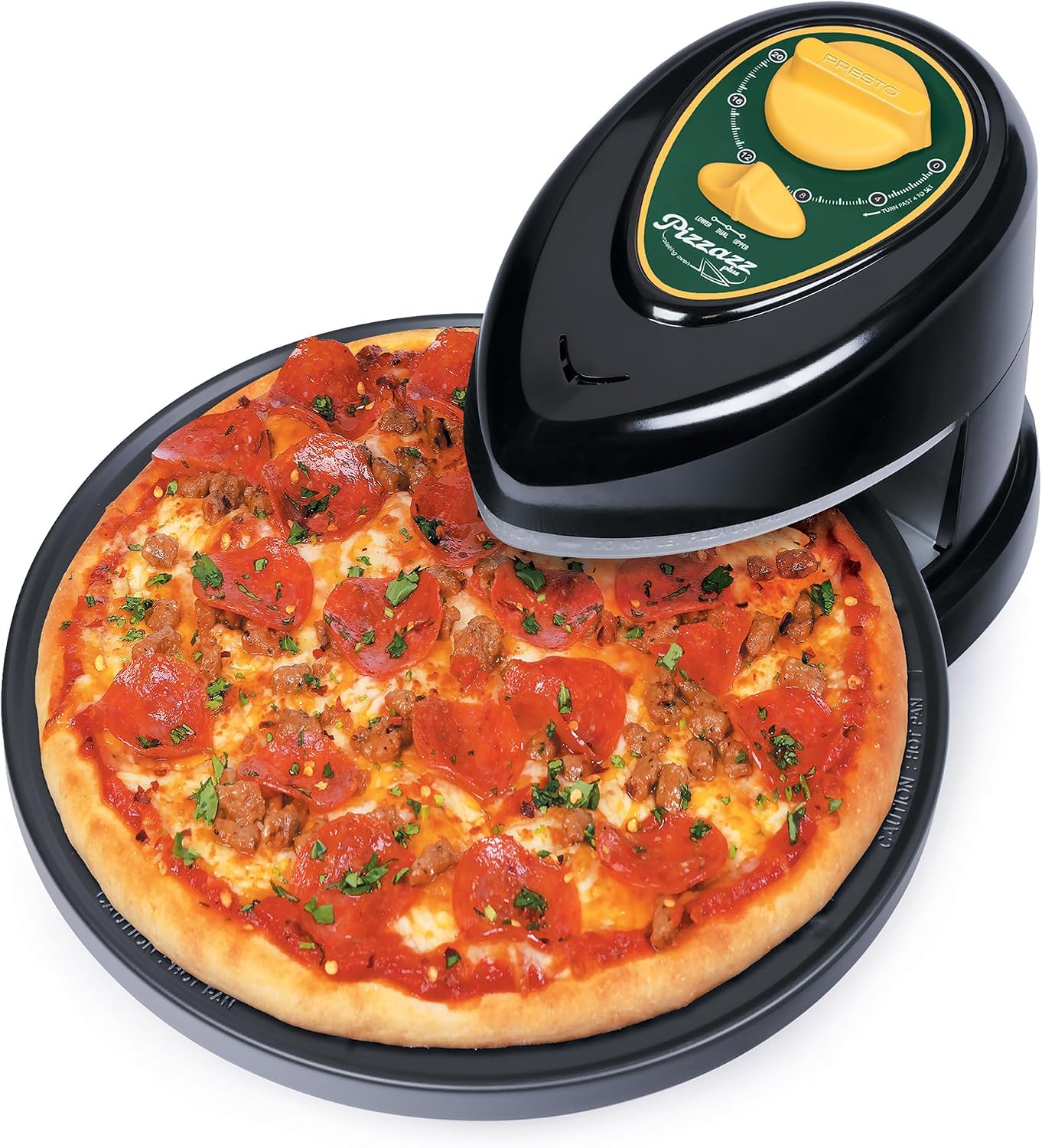
Budget pick: Presto 03434 Pizzaz Plus Rotating Oven
 Visit on Amazon →
This is the entry point to the class, and rotation is the whole idea. The oven turns the pie for you, so you are not standing over it with a peel and a prayer, spinning a pie mid-bake while one side of the rim scorches and the other stays blond. For a cook who is still learning to launch, that removes a variable at exactly the moment when you have the least attention to spare.
It is a single-purpose appliance, and it will hold a permanent spot on your counter or a permanent spot in your cabinet, which is a real cost in a small kitchen. The rotating platform also means round pies sized to the platform, not a sheet pan situation.
Flaws but not dealbreakers: This is the lower ceiling of the class. You will get an even bake, a set bottom, and color on the rim. You will not get the blistered, leopard-spotted rim of a dome running at full tilt, and that is a fair trade for the convenience and the footprint.
Anyone who wants pizza night without a ritual, and anyone who has never launched a pie before, should start here.
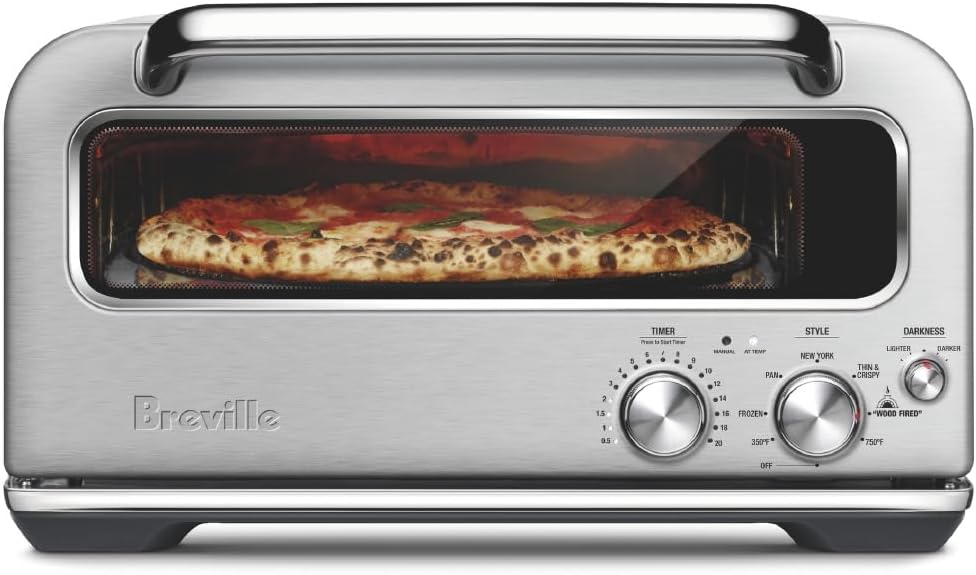
Upgrade pick: Breville BPZ820BSS Smart Oven Pizzaiolo, Brushed Stainless Steel
 Visit on Amazon →
This is the premium indoor electric, and it is the one I recommend to people whose pizza night is a Tuesday. It runs on a standard kitchen outlet, which means no fire, no propane, and no conversation with a landlord about a wood pile on the balcony. The brushed stainless finish is the least interesting thing about it, but it does mean the appliance looks like it belongs on a kitchen counter instead of in a garage.
The reason to pay for this class is control. Indoor electric ovens in this tier are built around preset programs and a stone that gets hot enough to set a base fast, so you are not nursing a flame and you are not guessing at a dial. You still have to preheat it properly and you still have to launch cleanly. The oven does not fix your dough.
Flaws but not dealbreakers: It is an oven-sized appliance. Measure your counter depth before you order, and think about where the door swings and where the heat goes. Any oven that runs this hot indoors will put some smoke in the air, so plan your first few bakes with a window open and the hood on. That is true of every oven in this class, not a knock on this one.
Anyone who wants a weeknight pizza that eats like a Saturday pie, and who has the counter to prove it, should look here first.
The actual workflow
Now the part that decides whether any of this works. This routine is the same whether you are running the rotating box or the premium indoor electric.
Step one: Preheat longer than the manual says. Most people preheat for ten minutes and wonder why the bottom is pale. A stone needs time to saturate, not just to warm up. Give it the full preheat cycle plus a few minutes, and do not launch the first pie the second the light changes. The stone is the battery. Charge it.
Step two: Measure the stone, not the dial. Point an infrared thermometer at the middle of the stone and read it. That reading is your real oven temperature. If the number is low, wait. If your oven has no way to get the stone hot enough, no amount of technique will save the pie, which is why the oven choice comes before the recipe.
Step three: Fix the dough first. The oven gets the credit, but the dough does the work. A 48-hour cold ferment in the fridge gives you flavor and a rim that puffs instead of tearing. If your dough is wet, slack, and warm, it will stick to the peel and you will blame the oven.
Step four: Keep the toppings dry and light. Sauce thin, low-moisture mozzarella, and no more than two or three toppings. Wet toppings steam the middle of the pie and turn the center to soup. A wet pie also drops the stone temp for the next one, and the second pizza is always where you notice it.
Step five: Flour the peel and commit. A light dusting of flour or semolina, shake the peel once to make sure the dough moves, then slide the pie off in one confident push. Hesitation is what produces the folded calzone you did not order.
Step six: Know your rotation plan before you launch. With the rotating oven, the machine handles the turn and you handle the clock. With a stationary indoor oven, you turn the pie once, about halfway through the bake, using tongs or a peel and not your fingers. Decide which one you are doing before the pie goes in.
Step seven: Watch the rim, not the timer. The timer is a suggestion. The rim is the truth. When you see color moving from gold to brown and the first dark spots appear, the pie is done or seconds from it. Standing at the oven for 90 seconds is the entire job.
Step eight: Rest the pie before you cut it. Sixty seconds on a rack. Cutting immediately lets the cheese run and the crust steam itself soft on the bottom. This is the step everyone skips and the step that separates a good pie from a great one.
Run that eight-step loop ten times and the oven stops being a gadget. It becomes dinner.
The competition and why it lost
The gas and wood-fired ovens are not in this article on purpose. A gas oven is easier than wood, and a wood-fired dome makes the best pie I have ever eaten, but neither one fits the question this guide is answering, which is how to get pizza on the table on a weeknight without a fire ritual. If you want Saturday, buy Saturday. This is the Tuesday guide.
Your regular kitchen range with a baking steel is the other competitor, and it is not nothing. A steel preheated hard will give you a decent bottom and a serviceable pie. What it will not give you is top heat, and without top heat you do not get leoparding, you get a uniform brown. That is the gap the countertop ovens in this guide are closing.
The accessory aisle is the last competitor, and it usually wins the wrong fight. Half of what is sold as a must-have solves a problem you do not have yet. A peel and an infrared thermometer cover most of it. Buy those two, then learn the oven you already have.
What this all costs
There are two tiers here and they sit far apart. The rotating budget oven is the lowest-risk way into the class: you spend little, you learn to launch, and the machine covers your worst habit. The premium indoor electric is a real appliance purchase, the kind you think about for a week and then use four times a month for years.
Check current Amazon price on both before you decide, because that is the number that changes. The technique does not.
The rest of the budget is small. A peel with a lip, an infrared thermometer, and a bag of the flour you actually like. Everything else can wait.
The math I care about is not the purchase price. It is the pies. An oven you use twice a month for three years is a different purchase than an oven you use twice and then store next to the bread machine. The countertop class exists so that the second kind of purchase stops happening.
That is the job. The oven is a heat machine. Get the stone hot, keep the dough simple, and let the rim tell you when it is done.