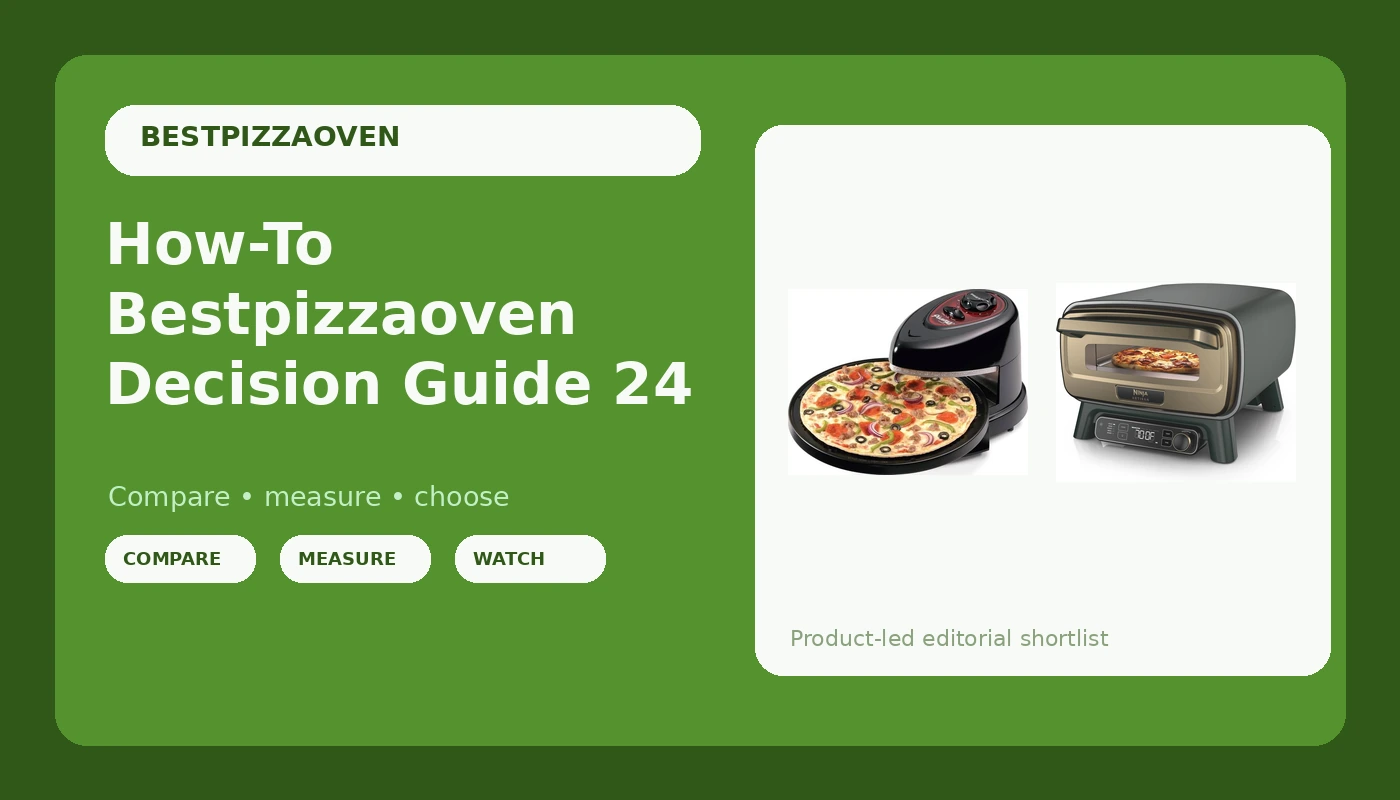
Choosing a pizza oven is not a personality test. You do not need to decide whether you are a wood person or a gas person before you have answered the practical questions: where will the oven live, how many pies will you cook, how much attention can you give it, and what kind of crust do you actually want? This how-to bestpizzaoven decision guide 24 is for making that decision without getting distracted by shiny temperature claims.
The short answer is simple. Choose an outdoor electric oven when you want a controlled, repeatable cook without a flame. Choose a compact countertop rotating oven when convenience, frozen pizza, and smaller pies matter more than Neapolitan-style heat. Choose gas or wood only when the ritual and outdoor setup are part of the point. The oven has to fit the night you will actually cook, not the Saturday night you imagine once a year.
Related: Best pizza oven for home use
Start with the cooking night, not the oven brand
Before comparing models, write down the last three pizza nights you really had. Were they weeknights after work? A backyard gathering? A quick frozen pie? A dough you fermented for two days? This sounds less exciting than comparing maximum temperatures, but it tells you more.
A pizza oven is a heat machine. The dough, sauce, and cheese need a stable place to cook. If you regularly want dinner on the table with no fire to tend, an electric oven has a strong practical advantage. If you enjoy feeding a fire, managing fuel, and watching the oven change as it heats, a wood-fired setup can be worth the extra work. Gas sits between those two: outdoor heat and quick control, without the full fire-tending ritual.
Do not buy an oven for an imaginary cooking habit. A large outdoor oven that stays covered because setup feels like a chore is a worse purchase than a smaller oven you use every week.
Step 1: Decide where the oven will live
Location narrows the decision quickly.
For an outdoor oven, plan for a stable, heat-safe surface, weather protection, ventilation, and enough room to work with a peel. A covered patio is not automatically a suitable indoor location. Fuel-burning appliances need the ventilation and clearances specified by their instructions. Do not move an outdoor gas or wood oven into a kitchen because it seems convenient.
An electric outdoor oven still needs a suitable outdoor setup and a safe power connection. The key benefit is control over the heat source, not permission to ignore placement or electrical guidance.
If you need to cook inside, look for an oven explicitly designed for indoor use. Indoor electric models trade some of the drama of a live fire for a simpler weeknight workflow. That trade is often sensible. Nobody gets extra points for lighting a fire at 7 p.m. on a Tuesday.
Step 2: Pick the heat style you can live with
Electric: control without the fire
The Ninja Artisan 5-in-1 Portable Pizza Oven in Green & Gold, MO201GN2 is an outdoor electric pizza oven with five functions: pizza, bake, broil, warm, and proof. Its product information lists five pizza settings: Neapolitan, thin crust, pan, New York, and custom. It is designed for 12-inch pizzas, includes a pizza stone and user manual, and lists a maximum temperature of 700°F. The supplied listing describes a 3-minute Neapolitan-style pizza at 700°F after an 18-minute preheat, with no turning required for that stated use.
Those details make it a useful fit for someone who wants outdoor cooking with electric temperature control and more than one pizza style. It is not a wood oven, and the 700°F ceiling is part of the decision. If your whole goal is a very high-temperature, extremely fast Neapolitan cook, compare that requirement honestly against the specification rather than assuming the word “artisan” answers it.
The listed price is $299.99, but Amazon pricing changes. Check the current listing for the Ninja Artisan 5-in-1 Portable Pizza Oven before buying.
Countertop rotating heat: convenience first
The Presto 03430 Pizzazz Plus Rotating Oven is a different kind of answer. It is a 1,235-watt countertop oven with a continuously rotating tray, separately controlled top and bottom heating elements, a timer, automatic shutoff, and a removable nonstick pan. The supplied product description says it handles frozen, homemade, take-and-bake, and deli pizza, plus other convenience foods. It accommodates pizza sizes from 7 to 12 inches, and the listed baking pan is 13 1/4 inches in diameter.
This is a convenience appliance, not a substitute for a high-heat outdoor pizza oven. Its strengths are the rotating tray, the ability to select top, bottom, or both heating elements, and a workflow that does not require preheating in the conventional sense. The description says it begins rotating and baking when plugged in. For a rising-crust pizza, the supplied instructions recommend running the lower element for 10 to 12 minutes before turning on the top element. For more bottom color, the description recommends finishing with bottom-only heat.
The listing provides a price of $92.93. Treat that as a supplied snapshot, not a promise. Check the current Presto Pizzazz Plus listing for the live price and availability.
Step 3: Match the oven to your pizza style
If your target is a Neapolitan-style pie with pronounced leoparding and a fast cook, temperature range and stone heat matter more than a long list of extra functions. You need to know what the oven can genuinely deliver and how much preheat time you will accept. Do not confuse a hot element or a marketing maximum with the temperature of the cooking surface.
If you mostly make frozen pizza, take-and-bake pizza, or casual homemade pies, a rotating countertop oven may be the more rational choice. Even baking and independent top-and-bottom control address the problems you are likely to notice first: pale toppings, an underdone base, or a top that finishes before the bottom.
If you make pan pizza, New York-style pizza, or several different formats, flexibility matters. The Ninja listing explicitly includes Neapolitan, thin crust, pan, New York, and custom settings. That does not guarantee that every style will match your favorite restaurant. It does tell you the product is aimed at more than one format.
If you are still learning dough, remember Rosa's rule: the oven gets the credit, but the dough does the work. A better oven cannot rescue dough that is over-proofed, under-proofed, or too wet to handle. Keep the dough variable steady while you learn what the oven is doing.
Step 4: Decide how much attention the bake should require
There are two kinds of convenience, and shoppers often mix them up.
The first is operational convenience. You press a control, set the heat, and follow a repeatable process. Electric ovens and countertop rotating appliances score well here.
The second is cooking convenience. Some people find a live fire relaxing. They want to adjust the flame, move the pie, and judge the stone by feel. That is not inconvenience to them. It is the evening.
Ask which one you want. If you dislike monitoring a flame, wood is not automatically more authentic in a useful way. If you love the ritual, an appliance with buttons may leave you cold even when the pizza is perfectly serviceable.
For beginners, fewer variables are usually kinder. A clear setting, a known preheat routine, and a peel that launches cleanly will teach you more than a complicated setup with fuel choices you do not yet understand.
Step 5: Check size and electrical details before buying
The product facts supplied for the Ninja list a 12-inch pizza capacity, 22.52 inches deep, 15.87 inches wide, and 12.36 inches high. The listing identifies it as green and lists a weight of 30.8 pounds. Those are not decorative details. They determine whether the oven fits your surface and whether you can move it when the weather changes.
The Presto listing describes a 13 1/4-inch-wide, 9 1/2-inch-high, and 17 1/2-inch-deep appliance with a removable baking pan for more compact storage. It requires 120 volts AC, 60 Hz, and lists 1,235 watts. Check the outlet and storage location before you order. A countertop appliance that has no sensible home becomes clutter, and clutter is a reliable way to stop cooking.
Capacity claims also need careful reading. A 12-inch pizza oven is not a 16-inch oven. A larger pizza may need a different launch, different turning room, and a different heat-recovery expectation. Buy for the pies you actually make, not for an occasional ambition to feed a crowd.
Step 6: Budget for the workflow, not only the appliance
The oven is only one part of the system. You may need a peel, a heat-safe surface, fuel or a safe power connection, and a place to store everything. You also need dough ingredients and enough time to learn the first few cooks.
Do not let accessories become a second shopping project. A peel and an infrared thermometer cover most of the useful information for an outdoor setup. You do not need a drawer full of gadgets before you make your first good pie. The important question is whether the accessory solves a problem you already have.
A lower-priced appliance can still be the right choice when its job is clear. The Presto is not trying to be a wood-fired dome. Its supplied features point toward convenience cooking, controlled top and bottom heat, and small-to-medium pizzas. That is a coherent use case. A product becomes a bad value when you buy it for a job its design was never intended to do.
A simple decision tree
Choose the Ninja Artisan if you want an outdoor electric oven for 12-inch pizzas, five pizza settings, other cooking functions, and a listed maximum temperature of 700°F. Its $299.99 supplied price should be checked before purchase, and its 18-minute preheat is part of the real workflow.
Choose the Presto Pizzazz Plus if you want a countertop appliance for 7- to 12-inch pizza, frozen or homemade pies, continuous rotation, separate top and bottom controls, and automatic shutoff. Its supplied price is $92.93, but the live listing may differ.
Choose neither yet if you are mainly chasing a specific restaurant-style crust but have not decided whether your space, power, ventilation, dough routine, and preheat patience support it. More research is cheaper than buying the wrong heat machine twice.
What to do after the oven arrives
Start with the instructions, not your most ambitious dough. Record the setting, preheat, pizza size, bake time, and what happened to the bottom. Change one variable at a time. If the top is done before the base, change the heat balance or finish with the bottom element where the appliance instructions support that approach. If the base is dark before the toppings finish, reduce the bottom heat or alter the position and timing.
Do not judge the oven by the first pizza alone. The first bake is often a lesson in launching, timing, and heat management. The second tells you more. A short log is more useful than a confident internet opinion because it reflects your dough, your surface, and your cooking habits.
Final recommendation
The best decision is the one that matches your ordinary pizza night. For outdoor electric control and a 12-inch format, the Ninja Artisan has a clear feature set: five pizza settings, five cooking functions, a supplied stone, and a listed 700°F maximum. For a compact countertop approach centered on convenience, smaller pizzas, and independent top-and-bottom heat, the Presto Pizzazz Plus makes more sense.
Gas is for Tuesday, wood is for Saturday, and electric is for the night when you want pizza without turning dinner into an event. There is no universal winner. There is only the oven you will preheat, use, clean, and reach for again next week.