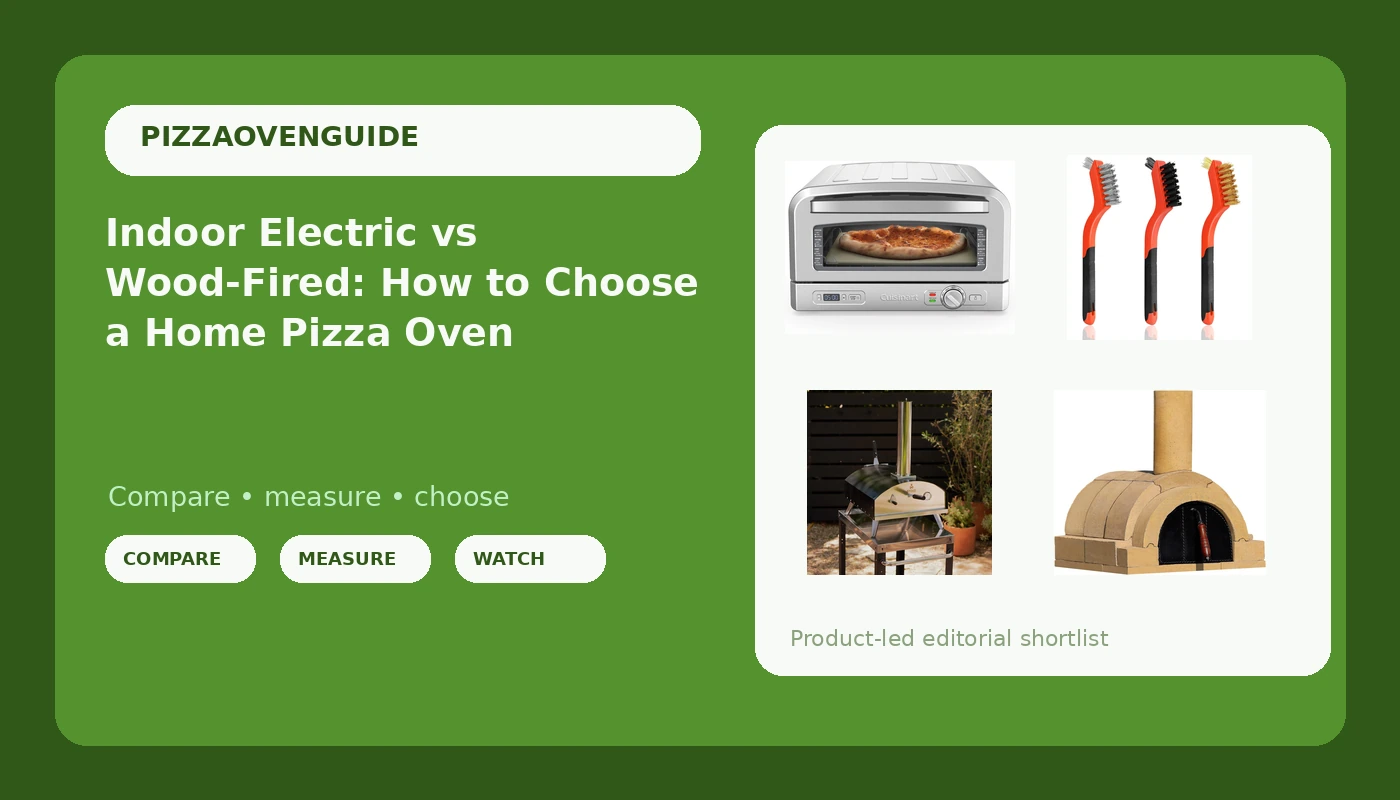
A home pizza oven is a heat machine. Everything else, the dough, the sauce, the cheese, exists to not get in its way. That is the first lesson from five years working a Neapolitan oven, and it is the first thing that disappears once you start comparing listings. Spec sheets sell window size, finish, and bundle contents. What decides whether you get leoparding on the rim and a bottom with real char is how hot the cooking surface gets, how well it holds that heat, and whether you will actually fire it up on a Tuesday after work. The four products below sit at different points on that map: an indoor electric countertop oven, a portable wood pellet oven, a firebrick kit you assemble yourself, and a small brush set that keeps the surfaces you cook on free of rust.
Related: How to Read a Pizza Oven Temperature Spec →
Quick answer
Match the oven to the night you cook most often, not the night you imagine. For indoor weeknights, a countertop electric oven with a stone is the practical pick: no fuel, no weather, no assembly. For weekend cooking outside, a portable wood pellet oven puts live fire in a package you can move. A firebrick kit suits a cook who wants a permanent outdoor oven and will spend an afternoon building it. The brushes are not an oven at all. They are the inexpensive maintenance piece that keeps rust off the metal you cook on.
Four useful options
| Model | Best fit | What stands out |
|---|---|---|
| Cuisinart Indoor Pizza Oven (CPZ-120) | Indoor weeknight baking | Countertop electric design listed to heat up to 700°F, includes a 12.5 inch stone |
| Stoke Wood Fired Outdoor Pizza Oven | Portable outdoor cooking | Wood pellet fuel in a stainless steel body sized for 13 inch pizzas |
| BRAVO Wood Burning Fire Brick Pizza Oven | A permanent backyard build | Full DIY kit with firebrick, refractory glue, trowel, gloves, cover, and gate |
| 3PCS Wire Brushes | Cleaning and rust removal | Three brushes with nylon, brass, and stainless steel bristles |
The indoor electric option: Cuisinart Indoor Pizza Oven
The case for electric indoors is simple: it removes every excuse. There is no fire to start, no pellets to buy, no wind to fight, and no reason the oven cannot be running by the time the dough finishes its second rise. The trade-off is ceiling and character. An electric countertop unit works within the range its element and stone can reach, and it will not give you the same floor as live fire. It also wants counter space, a nearby outlet, and clearance for the heat it throws. What it gives back is repetition, and repetition is how anyone gets good at this. If your pizza nights are weeknights, that trade is usually worth making.
The portable wood pellet option: Stoke Wood Fired Outdoor Pizza Oven
Pellets are the middle path between a gas knob and split wood. They feed a small, hot fire, they store easily, and they burn predictably enough that you can learn an oven's rhythm in a few sessions. The cost is that you are the thermostat. Nothing on a pellet oven holds a temperature for you, so the first pies tell you how fast the fire is running and how long to wait between launches. Portability cuts both ways as well: you can move it to a patio, a tailgate, or a friend's yard, but a light body holds less heat than brick, so recovery between pizzas takes longer. Plan on learning your oven's gap.
The build-it-yourself brick oven: BRAVO Wood Burning Fire Brick Pizza Oven
Thermal mass is the argument for brick, and it is a good argument. A firebrick floor absorbs heat during the burn and gives it back while the pizza bakes, which is what produces a fast, even bottom instead of a pale one. The catch is everything around the kit. This is a permanent outdoor build, so it needs a level base, clearance, and a decision about where it stays for years. Assembly is listed at around three hours, and the kit supplies the glue, trowel, gloves, gate, and cover, which shortens the process but does not remove it. What you get in return is a weekend ritual rather than a weeknight appliance, and that is a real difference in how often you cook.
The maintenance piece: 3PCS Wire Brushes
This is the least exciting item here and the one most people skip. Rust appears on grates, oven gates, and tools that live outside, and it appears faster than most new owners expect. The set covers the three jobs you actually have: a brass brush for softer metal where you do not want to gouge the surface, a stainless steel brush for heavier rust, and a nylon brush for anything delicate. Match the bristle to the material before you scrub. A stiff brush on the wrong surface removes more than rust.
Prices and availability may change. Product images, names, and retailer links are matched to verified listings. No current price, rating, stock status, or measured result is stated here without current evidence.
What the temperature number actually means
Manufacturers list a maximum temperature because it is the most flattering number on the box. Treat it as a peak, not an operating range. The figure that matters is the surface temperature of the stone or floor, because that is what touches the dough. Air inside an oven can read high while the stone is still lukewarm, and a pizza launched onto a lukewarm stone steams instead of baking. That is why an infrared thermometer earns its place in the toolkit: it lets you check the floor rather than trust a dial.
There is a second point, and it is the one that separates ovens in daily use. Heat is not only about the peak, it is about recovery. Every time you open a door or launch a pie, the surface loses heat, and the question is how quickly it comes back. A heavier stone or a brick floor returns that heat faster. A thin stone in a light oven needs a longer gap between pizzas, and that gap is where a well hydrated dough starts to stick to the peel. So read the listed maximum as one data point, then ask how much material is holding heat and how long the oven takes to recover.
Fuel, placement, and the night you actually cook
Fuel shapes everything downstream. Electric is indoor, controlled, and available whenever the outlet is. Pellets are outdoor, portable, and hands-on. Split wood and a firebrick oven are outdoor, permanent, and the most demanding of your attention. Placement follows from fuel, and placement is where most buying mistakes begin. A 13 inch oven on a balcony is a different product from the same oven on a patio with a work table beside it. Pizza size matters too, because the oven's stated capacity and your peel have to agree; a 12 inch pie in a 12 inch oven leaves no room for a sloppy launch. Work through the following before you order.
- Count the nights per week you will realistically cook pizza. If the answer is one, weight convenience higher than peak temperature.
- Decide where the oven lives and measure that space, including clearance for heat and for your hands.
- Choose the fuel you are willing to maintain: an outlet, a bag of pellets, or a wood supply.
- Match the stated pizza size to your peel and to the dough ball weight you actually mix.
- Budget for the accessories that change results: a peel, an infrared thermometer, and something to keep the cooking surfaces clean.
Practical guidance before you order
- Measure the counter or patio footprint first, then check the oven's dimensions against it.
- Confirm the oven's stated pizza size before buying a peel, so the two match.
- Expect preheat time. Electric ovens and brick floors both need the cooking surface to soak heat before the first pie goes in.
- Buy the peel and the infrared thermometer before any other accessory. Most of the rest solves problems you do not have yet.
- Plan for cleaning from day one. Rust on outdoor metal is normal, and the right bristle for the surface keeps ordinary maintenance from turning into damage.
Which option should you choose?
Choose the Cuisinart Indoor Pizza Oven when most of your pizza nights are indoors and you want a hot stone without fuel, weather, or assembly. Choose the Stoke Wood Fired Outdoor Pizza Oven when you cook outside and want live fire in a package you can move. Choose the BRAVO Wood Burning Fire Brick Pizza Oven when you want a permanent outdoor oven and are ready for an afternoon of assembly. Choose the 3PCS Wire Brushes when you already own an oven and want to keep its cooking surfaces and tools in usable condition.
One caveat worth stating plainly: listed specifications describe what a product is designed to do, not how it performs on your counter or patio. The strongest predictor of a good result is still a dough recipe you have made ten times.
The bottom line
The oven is a heat machine, and the fuel decides the schedule. Electric buys you repetition on weeknights, pellets buy you live fire you can carry, and firebrick buys you thermal mass and a weekend ritual at the cost of a permanent footprint. None of those is wrong, but only one of them matches the way you actually cook. Pick the fuel first, then the placement, then the size, and let the accessory list stay short until you know what your oven is missing. The first pizza you make in a new oven will probably be bad. Plan for it, cook the second one, and that pie will tell you what you bought.