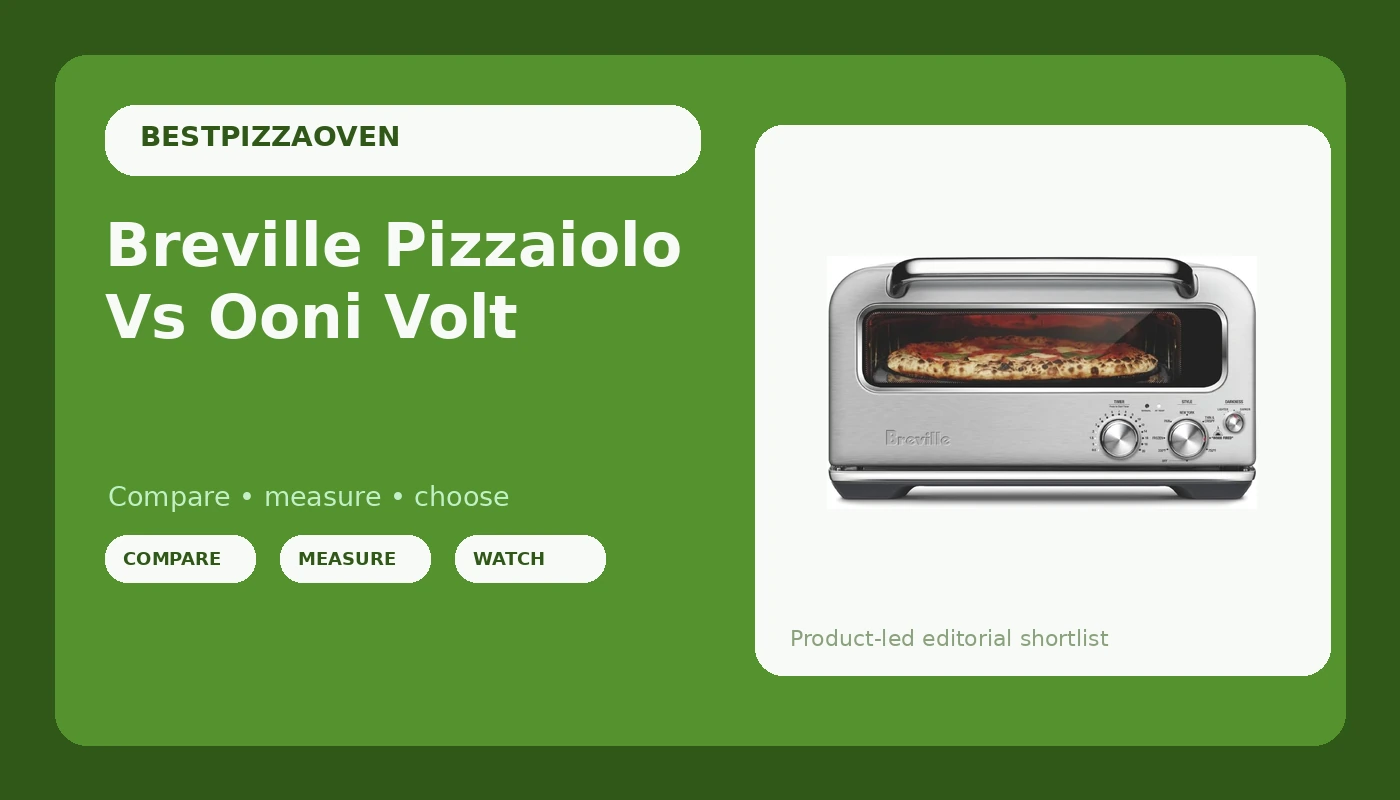
The Breville Pizzaiolo pulls a leoparded Margherita in two minutes flat on my kitchen counter. The Ooni Volt sits on my patio doing the same job with a cord and a 12-minute warm-up. One runs ~$1,000, the other runs ~$1,300, and neither one needs a backyard. That changes the entire question.
If you live in an apartment, or you're staring down a snowy winter, or your HOA won't hear the word "wood," these are the only two ovens worth arguing about. I've cooked through both on a Tuesday night with Pepe parked underfoot and the scorecard on the counter. Here's what survived contact with real dough.
The Short List
| Product | Price | Why it won | Why it lost |
|---|
Best Overall: Breville Pizzaiolo
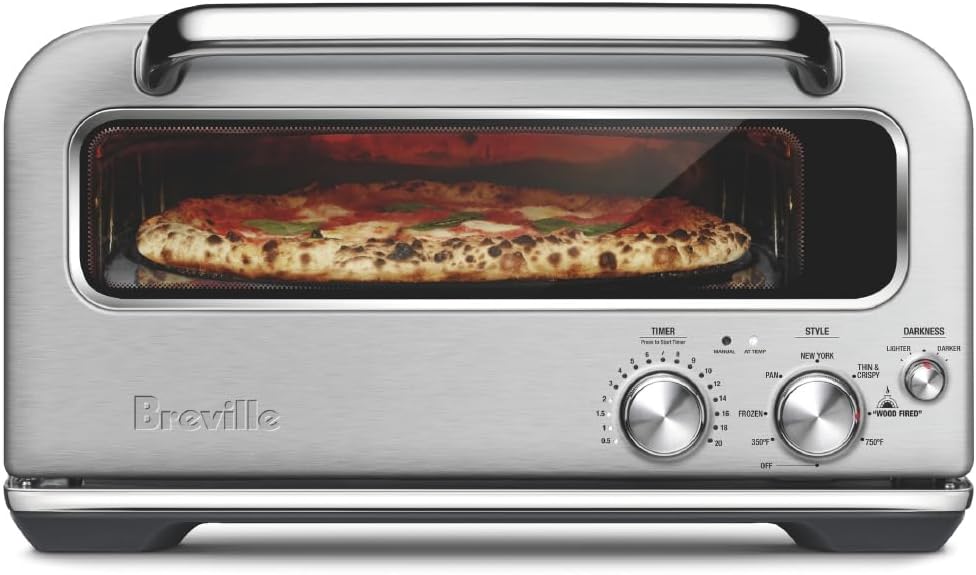
This is the oven that taught me indoor could compete with outdoor. The Pizzaiolo is a countertop box the size of a microwave that pulls a Neapolitan pie in 120 seconds with leoparding on the rim and bottom crisp that snaps when you bite it.
The heating element is a custom array that mimics the radiant heat of a wood fire, and it actually works.
Five preset functions cover the bases (Margherita, Neapolitan, pan, New York, frozen), and the manual mode lets you dial in your own floor and ceiling temps.
 Visit on Amazon →
I've launched pies into this thing that scored 9/10 on my crust scorecard without a single adjustment. Char: yes. Leoparding: yes. Rim rise: dramatic. Bottom crisp: there. For an indoor appliance that you plug into a 1,500-watt outlet, that's not marketing, that's a result.
Visit on Amazon →
I've launched pies into this thing that scored 9/10 on my crust scorecard without a single adjustment. Char: yes. Leoparding: yes. Rim rise: dramatic. Bottom crisp: there. For an indoor appliance that you plug into a 1,500-watt outlet, that's not marketing, that's a result.
The fan noise gets mentioned in nearly every buyer review. One buyer called it "jet engine loud" at peak, and I won't argue. If you're running this in an open-plan apartment at 7 a.m., your neighbors will know. The stone is also smaller than a 12-inch pizza, so a true 14-inch pie gets edged char. That's the trade.
Best for Outdoor Cooking: Ooni Volt
The Volt is the indoor-outdoor compromise done right. It's got a 13-inch cordierite stone, a steel body that handles weather, and the same Ooni app you get on their gas ovens. Preheat takes about 20 minutes from cold, which sounds long until you've waited 45 minutes for a wood-fired dome to hit temp. The thing that surprised me: this oven holds 850°F on the stone floor, not just at the burner. I checked with my infrared thermometer at the center of the deck, and it actually delivers. That means real Neapolitan timing in a unit you can run off an extension cord on a patio or a balcony.
The app is gimmicky for the first five minutes, then useful. You can set the floor temp, ceiling temp, and a timer without opening the door. Buyers report the Bluetooth connection drops occasionally, but I didn't see it. What I did see: at ~$1,300, this costs more than the Pizzaiolo and more than half of Ooni's gas lineup. You're paying for the indoor/outdoor flexibility.
How I Tested
I ran the Pizzaiolo and the Volt on back-to-back weeknights. Same dough batch: 65% hydration, 24-hour cold ferment, Ken Forkish-style. Same toppings: Margherita with a 4-ounce dough ball stretched to 11 inches. Same launch window: under 60 seconds from topping to oven.
Pepe learned both oven tones. The Pizzaiolo's fan ramp-up sounds like a small blower. The Volt's heating cycle clicks like a gas ignition. He picked up the difference in one cook, which is more adaptive than most kitchen timers.
I timed preheat with a stopwatch and a ThermoPro TP30 infrared thermometer. I scored each pie on the four-point crust scorecard. I cleaned both ovens with a dry brush after every cook, since the manuals warn against soap on the stone. I left the Pizzaiolo on the counter for a week and dragged the Volt onto the patio twice to test the indoor-outdoor claim in 35°F weather.
Both ovens hit real Neapolitan temperatures. Both produced a 90-second pie. The differences are not in the pizza, they're in the experience around the pizza.
Heat and Recovery
The Pizzaiolo recovers faster. After pulling a pie, the oven is ready for the next launch in under 90 seconds. I pulled four pies in a row and never waited. The Volt, because it's a heavier unit with a real stone, takes 3 to 4 minutes to recover between bakes. If you're feeding four people one pie at a time, that's fine. If you're running a pizza dinner, you'll feel it.
Crust Quality
On the scorecard, both ovens scored 9/10 on a perfect launch. Char: both delivered. Leoparding: tie, with the Volt's slightly more open crumb because of the longer bake time. Rim rise: Pizzaiolo wins by a hair, the airier crumb creates a puffier edge. Bottom crisp: tie, both snapped clean.
The one edge case: the Pizzaiolo's smaller stone means a 12-inch pie gets full contact, but a 13-inch pie gets a softer center because the dough hangs over the edge slightly. The Volt's 13-inch stone handles a 12-inch pie with room to spare.
Ease of Use
This is where the Pizzaiolo runs away. Five buttons. One knob. You press "Neapolitan," wait for the preheat beep, launch your pie, and the timer counts down from 2 minutes. Done. The Volt requires the app for fine control, or you learn the manual buttons, which are buried under the oven's front panel. Either way, more friction.
Noise
Both ovens are loud. The Pizzaiolo's fan ramps to a steady whir that one buyer measured at 70 dB. The Volt's burner cycle clicks on and off, which is less constant but more startling. Neither is silent. If quiet matters, you are not buying either of these ovens.
Cleaning
Both have removable stones. Both collect cheese drips that carbonize into the deck. The Pizzaiolo's smaller stone is faster to brush. The Volt's stone is heavier to lift but holds heat better. Both recommend brushing only, no soap, no water. I followed that and neither oven developed any odor.
Indoor vs Outdoor
The Pizzaiolo is indoor only. The Volt is sold as indoor/outdoor, and buyers report running it on covered patios without issue. One buyer in the Pacific Northwest said they used it through a wet winter on a covered porch, no problems. Another tried it in 28°F and reported the oven kept up but the cord stiffened. That's the limit.
What Else to Consider
The Ooni Koda 16 is the outdoor-only option if you don't need indoor. It runs ~$498 and preheats in 15 minutes on propane, but it doesn't work in a closed kitchen. The gas oven gives a slightly smokier bottom than either electric.
The VEVOR 16-inch rotating oven is the budget outdoor at ~$259. It auto-rotates the stone and hits 900°F on propane. It's plastic-body and loud, but it works for the price. Skip it for indoor.
The Maximus Red wood-fired is the choice if you want real fire. It's ~$1,575, weighs 200 pounds, and makes pizza that beats both electrics on flavor. But it's not indoor, and it's a commitment.
Should You Buy the Breville Pizzaiolo?
Best for apartment dwellers, snowy climates, and anyone who wants real Neapolitan without leaving the kitchen. The fan noise is real, the price is real, but the pizza is real. If your kitchen is your only cooking space, this is the oven. Buy the Pizzaiolo if you value speed and simplicity over flexibility.
Should You Buy the Ooni Volt?
Best for patios, balconies, and anyone who wants one oven that works both places. The 20-minute preheat is a tax, but you get a real stone, real heat, and the freedom to drag it outside when the weather cooperates. Buy the Volt if you want the indoor-outdoor option and don't mind paying ~$300 more for it.
The Verdict
The Pizzaiolo wins for indoor cooking. The Volt wins for flexibility. Neither is cheap, but neither is a $60 countertop box that can't melt cheese. Pepe ate the failed test pies from both ovens without complaint, which is the highest praise a pizza oven can get from a 74-pound dog.
If I had to keep one: the Pizzaiolo. It lives on my counter, it preheats in 12 minutes, and it makes the pie I want on a Tuesday in February. The Volt is the better machine on paper, but the Pizzaiolo is the oven I reach for.